
From the outside, trance mediumship can look deceptively simple. Somebody sits in a chair, their breathing slows, their voice changes and words are spoken. Depending on the observer, it may appear extraordinary, theatrical, moving or completely unconvincing.
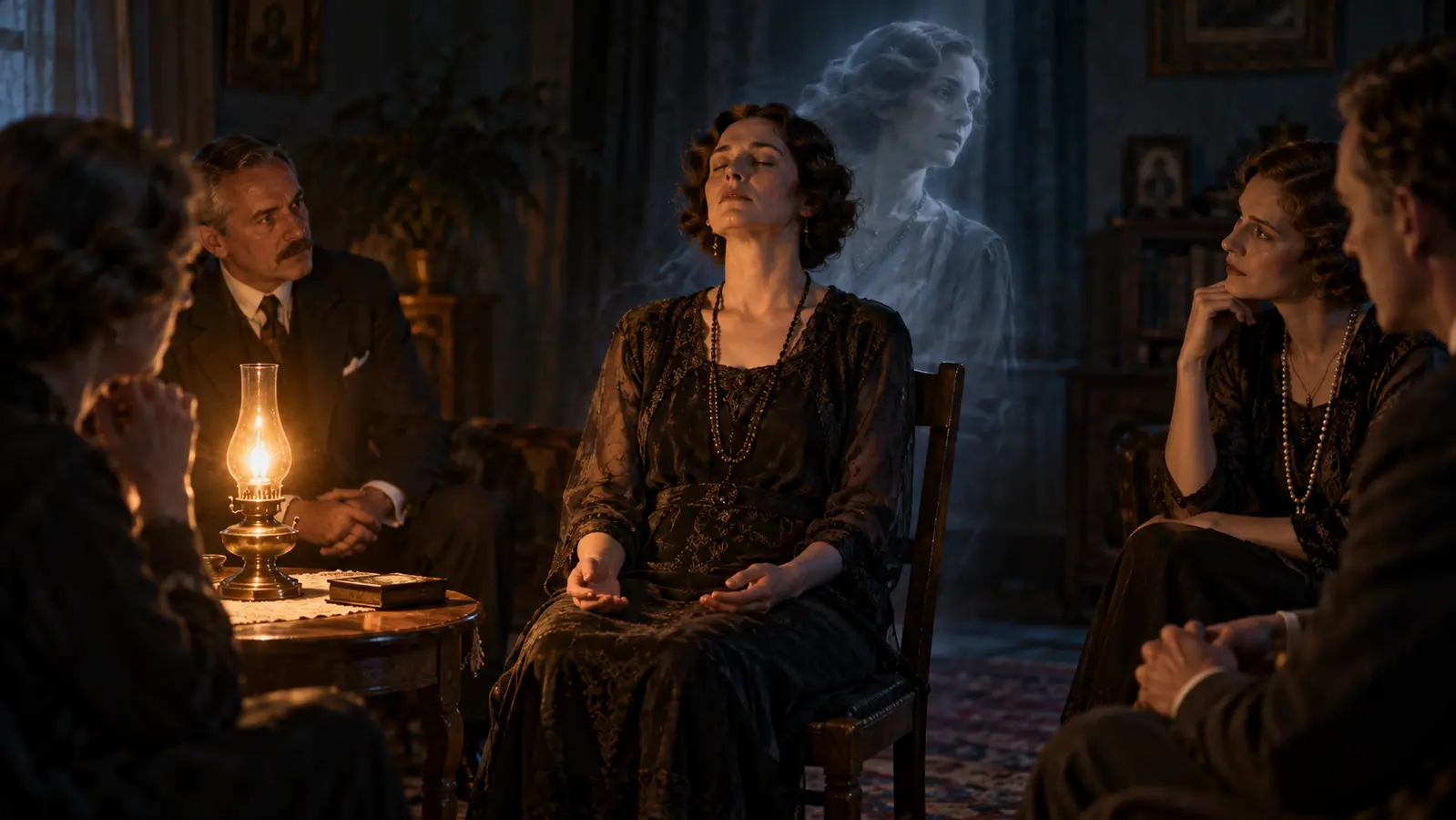
I have worked with trance and mediumship over many decades, and one thing I would say immediately is that the external appearance tells only a fraction of the story. The internal experience can vary tremendously, even for the same practitioner.
Trance is not one uniform state
The word trance covers many conditions. In psychology it may refer to absorbed attention, hypnosis-related phenomena or changes in awareness. In religious anthropology, possession and spirit-mediumship traditions have their own social, ritual and interpretive frameworks. Modern Spiritualist trance mediumship is a particular practice within that larger territory.
At one end, the medium may be fully aware of the room and words emerging, but feels the material arriving with an unusual autonomy. Elsewhere, attention can narrow profoundly, ordinary thought becomes distant, and later memory may be fragmentary. Neither a deeper appearance nor a dramatic voice automatically establishes a greater source of information.
I am wary of turning depth into a competition. One person’s quiet and clear communication may be more valuable than another’s spectacular performance.
The language beneath words
Much of my mediumship begins as impressions rather than sentences. I may receive an image, an atmosphere, a bodily sense, a sudden recognition or what feels like an entire personal history compressed into one instant. I then have to translate that into useful human language.
Translation is the difficult part. An image may be literal, symbolic or a mixture. A strong feeling may concern the communicator, the recipient, or something in my own memory stirred by the encounter. Experience improves the ability to distinguish possibilities, but it does not grant immunity from error.
That is why recipient feedback matters. Details should be offered as clearly as possible, not retrofitted after a reaction. A statement that could fit anybody is not the same as a precise and meaningful recognition.
What changes during a sitting?
An observer might notice slower movements, a different cadence of speech, changes in facial expression or unusually sustained attention. These can accompany altered states without proving a particular cause. The medium may report reduced ordinary self-talk, a sense of being moved aside, or a strong collaborative flow of language.
There are research questions here about attention, expectation, dissociation, memory and agency. Studies of automatic writing and trance have explored unusual patterns of neural activity, but the evidence base remains modest. It is not scientifically established that a communicating spirit produces these changes.

Responsibility matters more than spectacle
Mediumship often takes place in the presence of grief. People may be vulnerable, hopeful and attentive to every word. A careless statement can cause real harm. I believe practitioners should resist guarantees, frightening pronouncements and claims of infallibility.
If an impression is uncertain, say so. If a detail is wrong, let it be wrong. If somebody needs medical, legal or psychological advice, mediumship is not a substitute for the relevant professional help.
In my younger years I was involved in broadcasts and demonstrations, including work that exposed the tension between genuine communication and entertainment. Television likes a dramatic moment. The actual process often depends upon patience, nuance and an unhurried exchange that does not fit neatly between advertisements.
What have the years taught me?
Ability may bring someone to the work, but maturity determines how they carry it. The real discipline is to separate the incoming impression, the interpretation I place upon it and the conclusion the recipient draws. Those stages should not be casually fused.
I remain deeply interested in what mediumship may tell us about consciousness and survival. I also believe the subject is served best by honest records, careful distinctions and kindness towards the people who come seeking understanding.
A continuum rather than a switch
People sometimes imagine trance as an on/off condition. Either the medium is fully present or another intelligence has taken control. My experience has been subtler than that. There can be degrees of absorption, altered bodily sensation, changes in the spontaneity of speech and a variable sense of how much of the utterance is being deliberately formed. The word trance covers too much unless we describe these features separately.
The public may also mistake theatrical stillness for depth. A person can appear perfectly motionless while internally working hard, or seem outwardly ordinary while reporting a significant change in awareness. What matters is not the performance of trance but the relationship between intention, perception and communication.
From impression to spoken detail
In a reading I often begin with something difficult to name: a quality, relationship, image or felt association. Then comes translation. I try to turn what is subtle into ordinary detail that the recipient can understand and, where possible, recognise. That is an active stage, even when it feels very rapid. My vocabulary, memories and expectations inevitably shape the words available to me.
This means I should keep distinct the sensation that arrived, the inference I made from it, and what the recipient later said. Suppose an impression carries the atmosphere of a workshop: the smell of timber, an older man’s hands, a sense of careful making. I might infer a carpenter, but the recipient could know a cabinetmaker or someone who simply spent evenings restoring furniture. The original impression and my interpretation should not be rewritten after the fact as though I had said the exact answer from the beginning.
Some of the strongest learning comes from misses. Did I add a detail out of habit? Was I trying to rescue a vague statement? Did the recipient supply the specificity? I have worked in this area for decades and do not think honest examination threatens it. It can improve the craft and protect the sitter.
The research question of authorship
From a psychological perspective, automatic speech and writing raise questions about agency: how can an utterance feel unplanned or not wholly authored by the speaker? Studies of dissociation, absorption and automatic action show that the sense of producing an action can vary. From a spiritual perspective, the same event may be understood as communication from an independent source. Neither framework can simply announce victory by restating its preferred explanation.
A carefully documented session might use uninterrupted audio, a timestamped written account, and verification from someone who did not know the sitter beforehand. The exact wording should be preserved. Information already available publicly or through conversation should be noted. The goal is not to drain human warmth from the meeting; it is to prevent memory from polishing a striking moment into something it never was.
Why care for the recipient comes first
The visitor may be grieving, lonely, uncertain or frightened. The medium therefore has a responsibility beyond the accuracy of any isolated statement. The sitter must remain free to disagree, decline a direction or end the session. No one should be coerced into believing that a deceased loved one is displeased, or that a costly sequence of further readings is required to put matters right.
I have met many people through this work. Whatever a session may reveal about consciousness, it takes place between living human beings. Their dignity is not a secondary concern. A beautifully delivered statement that undermines someone’s judgement or dependence on their own relationships is not a success in my book.
What decades of practice have actually changed
I am less impressed by volume and drama than I was many years ago. A deep commanding voice can be compelling, but volume does not establish source. The apparent spontaneity of a message can be fascinating, but it does not settle authorship. Specificity, clarity, context and compassionate handling matter much more.
I have also become increasingly interested in the internal mechanics: what happens before the words, how much interpretation occurs, when awareness feels shared, and what remains after the state recedes. These are questions I can continue studying even when the ultimate nature of the source remains unresolved. To me, that is not a retreat from the mystery. It is a more mature way of respecting it.
A responsible record of a sitting
If I wanted to preserve a trance session for study, I would record the full session rather than selecting the most striking sentences. The date, participants and prior relationships matter. So do any cues in the room, questions asked, pauses, corrections and the sitter’s responses. A transcript that removes ordinary conversation can make a statement appear far more remarkable than it was in context.
There is also a difference between recording for personal development and publishing someone else’s grief. Consent should be clear, and identifying details protected where appropriate. The medium’s wish to demonstrate an ability must never override the sitter’s privacy.
After a session, I would separate the initial impression from the final words and from any subsequent verification. This is not easy when the translation happens almost instantaneously, but making the attempt teaches something about how impressions become language.
What trance means across cultures
Anthropologists have documented trance and possession traditions in many societies. The rituals, social expectations and understandings of personhood differ enormously. A ceremonial state in one community should not be treated as identical to a British Spiritualist demonstration merely because both are called trance in English.
The social setting may provide a framework for what is expected, what is permitted to be spoken and how the experience is interpreted. It can also provide support and a sense of meaning. Psychological research may investigate absorption, dissociation and agency; ethnography may reveal the experience’s role in a community; psychical research may ask whether verifiable information was conveyed. The disciplines are asking related but not interchangeable questions.
I find it helpful to keep all three views present. The form of the encounter is influenced by human culture, even when its participants understand the source as spiritual. Recognising that influence should make us more attentive, not more cynical.
Why spectacular demonstrations are not enough
A startling change of voice, unusual physical sensation or compelling atmosphere may impress an audience. But the performance does not establish the source of information. A small, quiet statement with precise details may be more evidentially interesting than an hour of dramatic speech. Even then, careful checking is essential.
For me the real discipline lies in resisting the temptation to make a sitting into a story about my own significance. The recipient came with their own questions, losses and hopes. Whatever I experience inwardly, I remain responsible for what I say aloud. That responsibility is inseparable from any serious discussion of trance mediumship.
Further exploration
- Explore historical records of the Society for Psychical Research, noting methodological controversies as well as reported phenomena.
- Compare cognitive studies of automatic writing and religious trance with ethnographic accounts; they study overlapping but non-identical practices.
The exploration continues
In a future article, I will explore how a trance medium prepares for a sitting and what the changing relationship between awareness and communication can feel like.
The experience comes first. The explanation must earn its place.


Worlds beyond.