
The phrase inner worlds can sound as though I am describing a particular realm, somewhere beyond the visible world, with a consistent landscape and a convenient entrance. My experience has been much less tidy — and far more interesting.
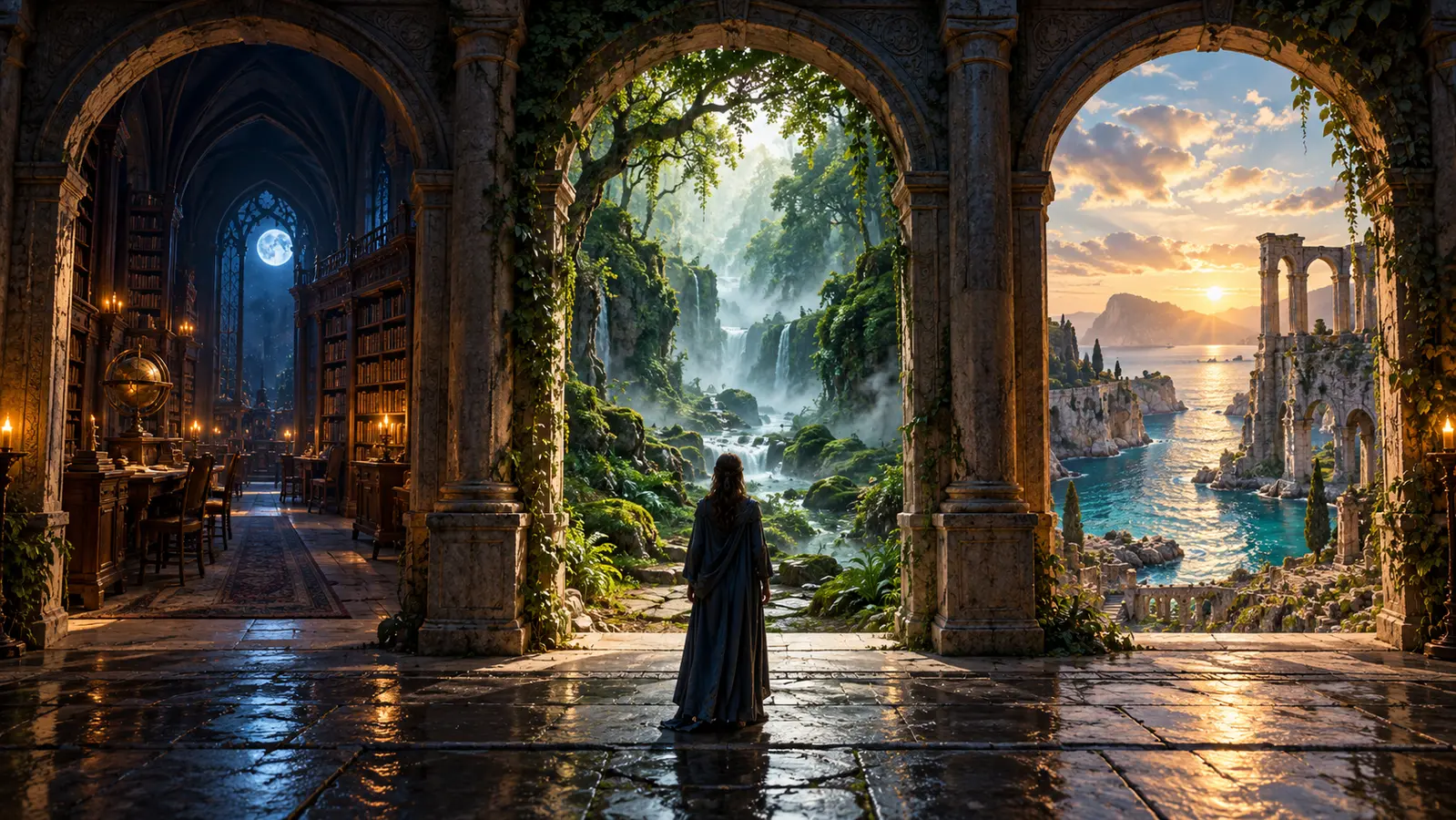
Dreams, trance, meditation, out-of-body-like states, inner imagery and deep stillness do not all feel the same. Nor do they necessarily share the same origins. Some contain buildings and figures; others have no recognisable scenery whatsoever. At times there is a strong individual identity. At other times the ordinary ‘Andrew’ seems almost absent.
Calling all of that one place would obscure the variety I am trying to understand.
A landscape is not always a location
During inner experience, architecture can be astonishingly coherent. I have encountered gates, curtains, corridors and rooms, sometimes with an impression that access has its own timing. The environment may feel as though I have arrived somewhere. Yet I cannot establish the independent geography of that place simply from how convincing it felt.
Ordinary dreaming already shows that the mind can construct a world with distance, perspective, familiar objects and emotional atmosphere. That is not an argument that every inner scene is merely a dream. It is a reminder that apparent spatial reality requires careful investigation.
Different modes deserve different questions
For a vivid dream I might ask about memory, emotions, narrative structure and whether I knew I was dreaming. For trance, I might ask how information arrived and whether it could be checked. For a powerful bodily energy sensation, I would note its location, duration, context and after-effects. For formless stillness, the most relevant question may concern continuity of awareness when ordinary imagery falls away.
The questions change because the experiences change.
| Mode | What may be noticed | What remains open |
|---|---|---|
| Dream | Scenes, stories, shifting identity | How and why the particular narrative formed |
| Lucid or observing dream | Awareness of, or within, dreaming | Degree and mechanism of reflective awareness |
| Trance communication | Speech, imagery, impressions, changed agency | Source, interpretation and verification of information |
| Inner spatial vision | Coherent landscapes or architecture | Whether a perceived place has independent existence |
| Formless stillness | Awareness with little ordinary content | How to describe its relation to self and brain |
This is a working classification, not a ladder of spiritual superiority.
The trouble with one master explanation
Some people prefer to call every unusual state ‘astral’. Others call everything symbolic or neurological. Each universal answer has the comfort of simplicity. It also risks flattening the evidence.
I would rather preserve the differences. A sensory image and a direct feeling of knowing may arrive together, but they need not be the same faculty. A vast spiritual impression and an intense emotion may overlap, yet one does not automatically explain the other.
Theories should be tested against experience, not used to rewrite it.

Forty years, and still learning
After decades of mediumship and exploration, I have become more interested in careful observation than in accumulating grand titles. Extraordinary experiences can be thrilling, unsettling, beautiful or simply matter-of-fact. I have learned not to assume that every event must deliver an instruction.
My method is to record what actually occurred, compare patterns over time, consider historical and scientific parallels, and keep the interpretation provisional where it needs to be.
That gives the Inner Worlds website its purpose. It is not a catalogue of certainties. It is a growing archive for people who are genuinely curious: those who wish to read deeply, compare ideas and perhaps recognise something of their own experience without being told exactly what to believe.
You may resonate with one article and not another. That is perfectly fine. I am not trying to gather an army of agreement.
I would much rather share a thoughtful conversation with a genuine seeker than collect a thousand fleeting clicks.
Why I resist the idea of one great inner country
When people speak about the spirit world, they sometimes describe a single destination. The details may be pleasant—beautiful landscapes, reunited families, a welcoming light—but the geography becomes strangely uniform. My own experiences have not encouraged that picture. Some have been places, some states of perception, some intimate encounters and others almost devoid of recognisable form.
I am not proposing a competing atlas with every hill and doorway labelled. I am saying that an atlas may be the wrong format for much of what consciousness presents. A dream landscape and the continuity of awareness in deep stillness are so different that I struggle to imagine why both should be called locations merely because both occurred outside ordinary sensory attention.
Five useful questions, not five fixed realms
If an experience has the character of a landscape, I want to know about space, distance, movement and continuity. If it is a presence or relationship, I ask about the felt nature of the contact and what was communicated, if anything. If it is a whole-life impression, I ask whether information seemed simultaneous or sequential and how it was translated into detail. If it is formless stillness, I ask what remained of identity, thought and time. If it involves divided awareness, I ask how the different perspectives related to one another.
This is a working vocabulary rather than a taxonomy handed down from heaven. Categories are valuable only while they preserve differences in the material. The moment a new account fails to fit, I would rather revise the categories than dismiss the account.
The role of expectation
Anyone who has read widely in spiritual literature acquires a rich store of images and concepts. Those can help with interpretation, but they can also become a filter. A person who expects celestial cities may notice architecture; someone trained in a chakra system may instinctively locate sensations along that map. That is not a reason to reject every such report. It is a reason to record the raw experience before reaching for the nearest explanation.
I have caught myself thinking in spatial terms even when the experience may have been more like a change of condition. The mind is extraordinarily good at making a scene out of something difficult to describe. It supplies direction, scale and a relationship between observer and observed. Perhaps at times that translation is useful; perhaps it also introduces misleading detail.
When ordinary words fail
Our language is designed for tables, bodies, weather, journeys and conversations. We borrow those words for experiences that may lack physical size or sequence. We say we went ‘higher’ or ‘deeper’, entered a ‘place’, crossed a ‘threshold’ or met a ‘being’. These descriptions may be quite faithful to how something felt, but their grammar quietly suggests a physical world with directions and objects.
For that reason I distinguish the report from the analogy. If awareness seemed to widen, did I actually perceive a spatial expansion, or did the range of what could be known simply feel greater? If a presence seemed near, was there a direction from which it arrived? If a whole life was perceived, did it appear as images, or was it an immediate quality later converted into narrative?
Such distinctions may sound overly careful until one tries to compare years of records. Then they become essential. An entire theory can be built on an ordinary preposition such as above or within.
What genuine seekers deserve
I would have loved to encounter a resource that treated these subjects with both openness and intellectual care when I began studying them. Too much material demands either unquestioning belief or immediate dismissal. Neither attitude helps someone who has spent years exploring an experience and wants to understand its texture.
I want Inner Worlds to be a place where the reader can stay with a question. There should be enough history to understand where our concepts came from, enough science to know what has actually been measured, and enough first-person honesty to avoid turning living experiences into neat textbook boxes.
There may never be one satisfying final map. I am comfortable with that. The diversity of experience is itself worth studying. The further I go, the more important it seems to preserve that richness, rather than flatten the inner worlds into one familiar destination.
The problem of communicating a formless experience
An inner landscape can be described almost like a travel account: architecture, distance, movement, colour, weather. But what happens when there are no recognisable forms? The account becomes harder because the ordinary grammar of perception assumes a subject looking at an object. In some states that distinction seems weak or absent.
I have described periods of stillness in which awareness remained yet there was little to report as scenery. The return could be sudden, with a distinct bodily sensation, but the interval itself did not resemble a visit to a place. I would not want to manufacture scenery merely to make the story easier to publish.
These experiences deserve careful language precisely because they cannot be illustrated by another fantasy gateway. Sometimes an absence of image is a defining feature. We can still discuss continuity, self-reference, memory and the manner of return.
Why stories should be compared slowly
With a long archive, recurring patterns become more interesting than isolated dramatic events. I might compare occasions when an environment felt unusually ancient, when awareness seemed split between observer and participant, or when an entire life was apprehended as one field. Similarities can be noted without declaring that all such episodes occurred in the same realm.
The timing matters. Were they close to sleep? Did a particular meditation practice precede them? Was there a strong emotional event that day? What was remembered immediately, and what emerged later as I considered the experience? An honest chronology allows new questions to arise that a polished retrospective narrative might hide.
That is one reason I want the experiences written down for my family and for genuine seekers. Memory is not static. A record made close to the event has a value that no later reconstruction can replace.
The website as an evolving study
Inner Worlds should not become a catalogue of confident one-line answers. If a reader is drawn to one subject, I want them to find enough material to explore it properly: the history of the concepts, examples from lived experience, technical distinctions where appropriate, and links to related studies. They should be able to disagree with an interpretation and still find something valuable in the account.
The site’s structure can reflect that spirit. Articles can connect through themes—dreaming, mediumship, contemplative stillness, spiritual traditions, and the science of consciousness—without forcing every subject onto a single grand ladder. Over time, the archive can become richer as new experiences are compared with older ones.
I do not need thousands of fleeting readers. I would rather the right person encounter an article at the right time and feel invited to think more deeply. That is a quieter ambition, but it suits the work I want to leave behind.
Further exploration
- Read this alongside our earlier articles on the architecture of inner experience, dreams and awareness, and the language of subtle sensation.
- Compare phenomenological methods of careful first-person description with laboratory research on sleep, attention and perception.
The experience comes first. The explanation must earn its place.
Worlds beyond.